Introduction
The Middle East is emerging as a promising growth region in the global shapewear market. Although still considered a developing market compared to North America and Europe, it shows strong potential driven by urbanization, rising disposable income, and evolving fashion preferences.
For distributors, wholesalers, and private label brands, understanding consumption trends in this region is essential for building a successful market entry strategy. Unlike Western markets, shapewear demand in the Middle East is shaped by cultural norms, climate conditions, and occasion-based purchasing behavior.
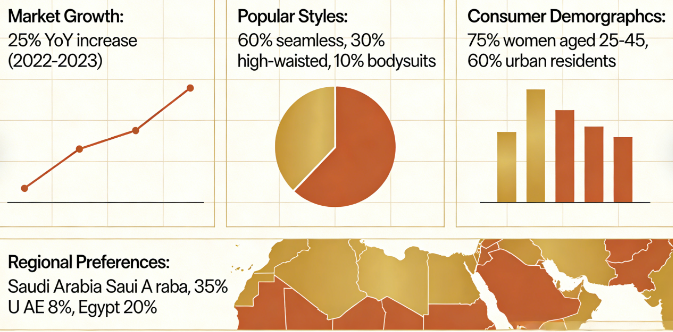
1. Market Growth: A High-Potential Emerging Region
The Middle East shapewear market is experiencing steady growth, supported by increasing awareness and lifestyle changes.
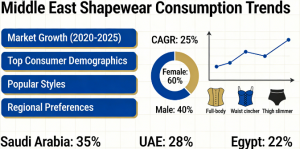
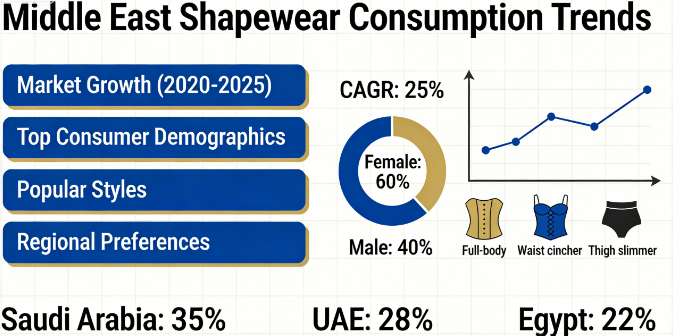
- The regional market is projected to grow at around 7.8% CAGR, reaching over USD 140 million by 2028
- In GCC countries alone, the market has already reached significant scale, driven by fashion awareness and retail expansion
Urban centers such as Dubai, Riyadh, and Doha are leading this growth, with consumers increasingly adopting global fashion trends.
Buyer Insight:
- Enter early to capture market share
- Focus on premium and mid-range segments
- Target urban retail channels
2. Occasion-Based Consumption Dominates
Unlike Western markets where shapewear is often used daily, in the Middle East it is largely event-driven.
- Around 30% of purchases are linked to special occasions such as weddings and formal events
- Shapewear is commonly worn under traditional or formal clothing
This creates a unique demand pattern where consumers prioritize fit, invisibility, and comfort for long wear.
Buyer Strategy:
- Promote shapewear as an “occasion essential”
- Focus on premium finishing and comfort
- Offer elegant packaging for gifting markets
3. Modest Fashion Drives Product Design
Modest fashion plays a key role in shaping product demand.
Consumers prefer shapewear that:
- Works under loose or layered clothing
- Provides full coverage rather than exposure
- Enhances silhouette subtly without being noticeable
This aligns perfectly with shapewear’s core function, making it highly compatible with regional fashion styles.
Product Direction:
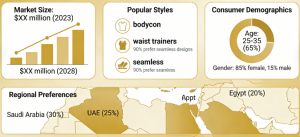
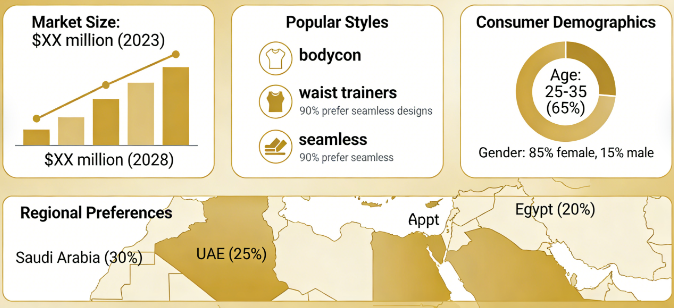
- High-waist shaping shorts
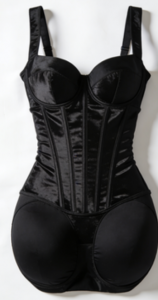
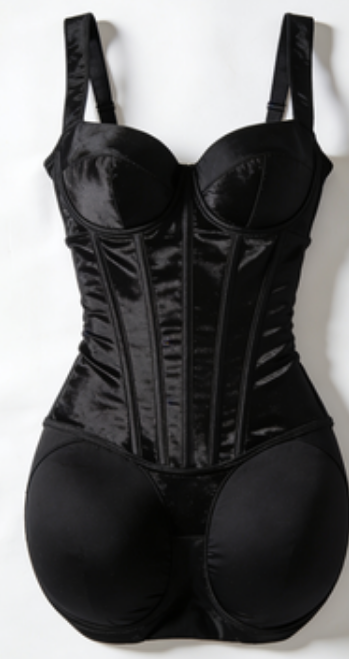
- Full-body shapewear
- Seamless and invisible designs
4. Climate Impact: Breathability is Critical
The Middle East’s hot climate significantly influences product selection.
Consumers prioritize:
- Breathable fabrics
- Moisture-wicking performance
- Lightweight and seamless construction
Seamless shapewear with thermoregulation is becoming essential rather than optional in this market
Buyer Strategy:
- Avoid thick or overly compressive products
- Focus on lightweight, breathable materials
- Highlight cooling and comfort features
5. Rising Demand from Younger Consumers
Young, urban consumers are driving shapewear adoption.
- Around 25% of women in major cities use shapewear, especially for styling and confidence
- Social media and Western fashion influence are accelerating demand
Additionally, there is a growing interest in male shapewear, although still in early stages
Buyer Insight:
- Target younger demographics (18–35)
- Use modern branding and digital marketing
- Consider expanding into men’s shapewear
6. Distribution Channels: Retail Still Dominates
Unlike some regions, offline retail remains highly important.
- Around 60% of shapewear sales come from retail stores
- However, e-commerce is growing rapidly, already accounting for ~35%
This creates a hybrid distribution model.
Channel Strategy:
- Combine supermarket & mall retail with online sales
- Partner with local distributors
- Develop e-commerce-ready product packaging
-
Conclusion
The Middle East shapewear market offers strong growth potential for global buyers, but success requires a localized strategy.
Key takeaways:
- Demand is event-driven and culturally influenced
- Climate requires breathable, lightweight products
- Retail and e-commerce both play important roles
- Consumers prioritize comfort, quality, and subtle shaping
For wholesalers, distributors, and private label brands, adapting to these unique consumption patterns is the key to unlocking long-term growth in the region.
Post time: Mar-28-2026