
Silicone Bra Pasties: International Size Conversion Guide
As an intimate fashion accessory, silicone bra pasties are an essential item for both daily wear and special occasions. Choosing the correct size not only ensures a secure fit and wearing comfort but also allows the pasties to deliver their optimal support and shaping effects. However, bra sizing systems vary across different countries and regions—with distinct standards in markets such as Europe, the Americas, Japan, Korea, Australia, and New Zealand. To help consumers worldwide accurately select the perfect-fitting silicone bra pasties, this comprehensive international size conversion guide provides a complete overview covering core measurement methods, regional sizing systems, conversion techniques, and product selection tips.
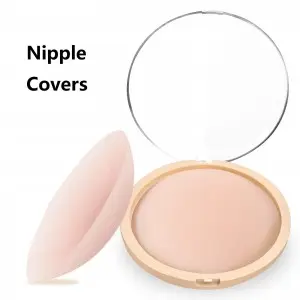
I. The Prerequisite for Choosing the Right Silicone Bra Pasties: Accurate Measurement of Basic Bust Dimensions
Regardless of which regional sizing standard you reference, accurately measuring your own key bust dimensions is always the first step. The size selection for silicone bra pasties is primarily based on the difference between your upper bust circumference and your underbust circumference. Small details during the measurement process directly impact data accuracy, so it is crucial to strictly follow the guidelines below:
Measurement Tool: Use a non-stretchable soft tape measure. Keep the tape level and snug against your body—but not so tight that it feels constricting—to avoid measurement errors caused by pulling or stretching.
Measuring Underbust Circumference: Wrap the soft tape measure around your torso just beneath your bust, at the point where it sits closest to your ribs. Record the measurement in centimeters (cm); this serves as the foundational dimension for determining your size.
Measuring Upper Bust Circumference: Stand naturally with your chest lifted and head held high. Wrap the soft tape measure around the fullest part of your bust (at the nipple level) and record the measurement. If you have a fuller bust, consider taking three separate measurements—while standing upright, while bending forward at a 45-degree angle, and while bending forward at a 90-degree angle—and calculate the average of these values to ensure a more precise result. Calculating Cup Size: Subtracting the underbust measurement from the overbust measurement yields a difference value that corresponds to the specific cup size. This calculation serves as the fundamental basis for matching the support level of silicone breast pasties. The universal standard for classifying cup sizes based on this difference is as follows:
AA Cup: Difference ≤ 7.5 cm
A Cup: 7.5 cm < Difference ≤ 10 cm
B Cup: 10 cm < Difference ≤ 12.5 cm
C Cup: 12.5 cm < Difference ≤ 15 cm
D Cup: 15 cm < Difference ≤ 17.5 cm
E Cup: 17.5 cm < Difference ≤ 20 cm
F Cup and Above: For every additional 2.5 cm increase in the difference, the cup size increases by one level.
II. Analysis of Major Global Sizing Systems for Silicone Breast Pasties
Due to differences in lingerie design philosophies and distinct regional body shape characteristics, various countries and regions have developed their own unique sizing conventions. Currently, the global market is dominated by five major sizing systems: European (EU/UK), American (US/Canada), Japanese, Korean, and Australian/New Zealand. As a lingerie accessory, silicone breast pasties strictly adhere to the specific lingerie sizing standards of each respective region. The specific sizing rules are outlined below:
(I) European Sizing (EU/UK): Centimeter-based; Simple and Standardized Notation
The European and UK sizing system for silicone breast pasties centers on a combination of the underbust measurement (in centimeters) and the corresponding cup letter. It is the most widely adopted and easily understood sizing system globally. The underbust measurement is derived directly from the measured value; if the measurement is not a whole number, it is rounded up to the nearest multiple of five. For example, an underbust measurement of 71 cm is labeled as 75, while 76 cm is labeled as 80. Common underbust band sizes include 65, 70, 75, 80, 85, 90, 95 cm, etc. The cup classification strictly follows the universal difference-based standard described above, without any additional adjustments; for instance, 75B, 80C, and 90D are classic examples of European sizing notation. (II) US/CA Sizing: Underbust Measured in Inches; Subtle Cup Adjustments
The US and Canadian sizing system uses inches as the unit of measurement for the underbust circumference. Additionally, the cup size differentiation—based on the difference between bust and underbust measurements—varies slightly from universal standards. The sizing format consists of a number (representing the underbust measurement in inches) followed by a cup letter.
Underbust Conversion: 1 inch = 2.54 cm. Common US underbust sizes are labeled as 30 (corresponding to 65 cm), 32 (70 cm), 34 (75 cm), 36 (80 cm), 38 (85 cm), 40 (90 cm), etc., representing the nearest whole-inch value to the actual measurement.
Cup Adjustments: The cup size increments in the US system are slightly larger than those in universal standards. Specifically, the bust-to-underbust difference for an A cup is 10–12 cm; for a B cup, it is 12–14 cm; for a C cup, 14–16 cm; and so on. Consequently, for the same style of silicone breast forms, a US size 34B roughly corresponds to a European size 75C. When making a selection, it is important to pay attention to these subtle differences in cup sizing.
(III) JP Sizing: Smaller Values; Underbust Labeled Using Universal Codes
The Japanese sizing system for silicone breast forms is tailored to the body characteristics of Asian women; consequently, the overall dimensions tend to be smaller. The sizing format consists of a number followed by a cup letter. The underbust numbers serve as universal simplified codes, corresponding to European underbust measurements (in centimeters) as follows: 65 (EU) = S, 70 (EU) = M, 75 (EU) = L, and 80 (EU) = XL. The cup size differentiation adheres to universal standard increments—for example, a Japanese size M/A corresponds to a European size 70A, and an L/B corresponds to a European size 75B. This is one of the most widely used sizing systems in the Asian market. (IV) Korean Sizing (KR): Aligned with Japanese Standards for Simpler Labeling
The Korean sizing system is highly aligned with Japanese standards and is similarly tailored to the body types of Asian women. Sizing labels for silicone breast petals typically consist of a letter (representing the underbust measurement) followed by a cup letter; some brands, however, may use numerical labels directly. The correspondence for underbust measurements is as follows: 65cm = XS, 70cm = S, 75cm = M, 80cm = L, and 85cm = XL. Cup sizing involves no additional adjustments and adheres to universal standards—for instance, a Korean size S/B corresponds to a European size 70B, while M/C corresponds to a European 75C. This labeling style is concise and highly legible.
(V) Australia/New Zealand Sizing (AU/NZ): Identical to UK Sizing, Tailored to Southern Hemisphere Body Types
The sizing systems in Australia and New Zealand are completely identical to those in the United Kingdom. Underbust measurements are expressed in centimeters, and cup sizing follows universal standards. The labeling format consists of the underbust measurement (in centimeters) followed by a cup letter. The only distinction is that silicone breast petals from Australian and New Zealand brands feature a design cut specifically tailored to the body characteristics of women in the Southern Hemisphere—specifically, the side adhesive area is slightly widened. However, the actual size values are directly interchangeable with European and UK sizing; for example, an AU/NZ size 75D is completely identical to a European 75D or a UK 75D.
III. Universal International Size Conversion Chart for Silicone Breast Petals
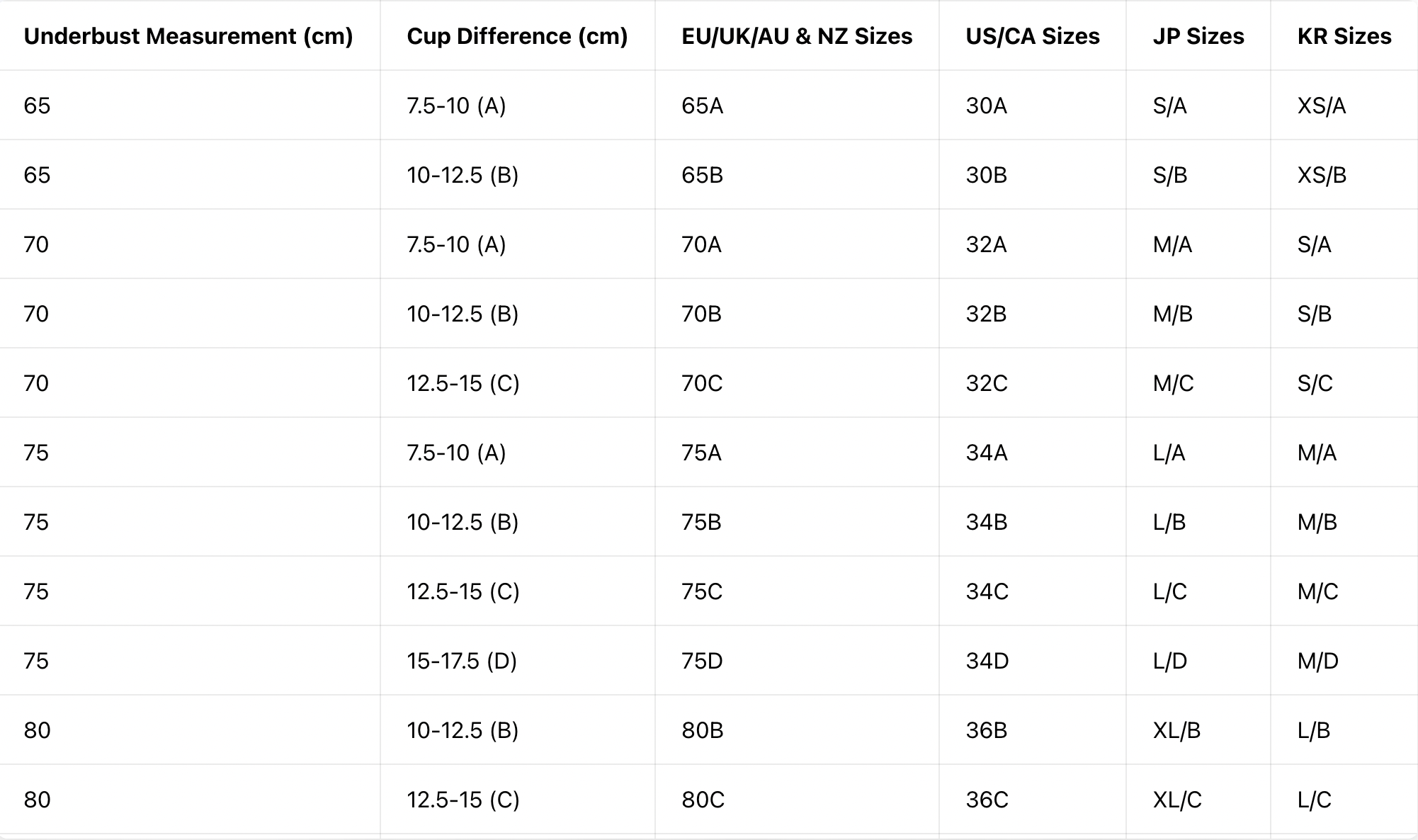
To enable consumers worldwide to quickly convert sizes across different systems, and based on regional labeling conventions and actual fit characteristics, we have compiled a universal conversion chart covering core underbust and cup measurements. This chart encompasses the most common size ranges and serves as a direct reference guide for selecting silicone breast petals; all listed values represent the closest corresponding fit.
IV. Key Strategies for International Sizing of Silicone Bra Inserts: Avoiding Common Pitfalls
Due to variations in material thickness and design styles (such as push-up, ultra-thin, or strapless models) across different brands, silicone bra inserts may offer varying degrees of actual fit—even if their labeled sizes appear identical. Drawing upon global market product selection expertise, here are several practical tips to help you achieve a precise match:
Prioritize the Brand’s Own Sizing Chart: Each international brand fine-tunes its sizing details based on its specific product designs. When shopping, always consult the exclusive sizing chart found on the brand’s official website first; while this guide provides general standards, the brand’s own chart serves as the definitive reference.
Adjust Sizing Based on the Occasion: For casual daily wear, you can select silicone inserts that align exactly with your measured size. For events requiring enhanced lift and shaping—such as weddings or evening galas—consider going up one cup size to ensure stronger support. Conversely, when wearing tight-fitting formal gowns, consider going down one band size (underbust measurement) to ensure a snugger fit and prevent slippage.
Account for the Elasticity of Silicone Material:High-quality silicone inserts are crafted from highly elastic, food-grade silicone, offering a slight degree of stretch and adaptability. If your measurements fall exactly between two standard sizes, those with a slender physique should opt for the smaller size, while those with a fuller figure should choose the larger size.
Match Cup Shape to Your Natural Bust Contour: Beyond numerical size, the specific shape of the silicone cup—whether round, teardrop, or mango-shaped—significantly impacts the quality of the fit. Western brands (Europe/US) often feature teardrop or mango shapes, which are better suited for fuller busts; conversely, Japanese and Korean brands typically favor round shapes, designed to complement smaller, rounder busts. For the best results, select a cup shape that complements your specific body type *before* determining the appropriate numerical size.

V. FAQ: Resolving Common Doubts Regarding International Sizing
1. Is the sizing for wire-free silicone bra inserts interchangeable with that of underwire bras?
Yes, they are interchangeable. The sizing criteria for silicone bra inserts mirror those of conventional bras, relying primarily on the underbust measurement and the cup-size difference (the gap between the bust and underbust measurements). The absence of underwires affects only the wearing sensation and comfort level, not the fundamental sizing standards.
2. How do I convert international sizes for large-cup silicone bra inserts (Cup E, F, and above)? Size conversions for larger cup sizes adhere to the core rules outlined in this guide; one simply needs to advance sequentially through the cup grades. For instance, European size 80E corresponds to US size 36E, Japanese size XL/E, and Korean size L/E; similarly, European size 85F corresponds to US size 38F, Japanese size XXL/F, and Korean size XL/F. The conversion relationships for the underbust measurement remain unchanged.
3. Do I need to adjust the size when choosing silicone pasties of different thicknesses?
No specific adjustment is required. Silicone pasties—whether thin (0.3–0.5 cm), medium-thick (0.8–1 cm), or thick (1.2–1.5 cm)—all follow a unified sizing standard. The thickness affects only the shaping effect, not the fit; therefore, you can simply select your size based on your basic
Post time: Mar-25-2026