New Trends in the Global Shapewear Market: Why Can Silicone Butt Pads Break Through the Market Boundaries of Traditional Shaping Pants?
As the global shapewear market gradually recovers from the post-pandemic slump—with the US market restocking rate rising from 39% to 45% and the average price reduction in the UK market narrowing by 4 percentage points—a clear trend is emerging: consumer demand for “shaping” has long since shifted from “full-body wrapping slimming” to more specific demands for “precision, comfort, and scenario-based” solutions. In this wave, the market limitations of traditional shapewear (such as tummy control pants and sharkskin pants) are becoming increasingly apparent, while silicone butt pads, as an emerging category, are breaking through the market boundaries of traditional categories with their unique product strengths and market adaptability, becoming a new growth point in the global shapewear market.

I. Iterative Demand: From “Full-Body Wrapping” to “Precise Shaping,” Consumers Want More Than Just “Slimming” The core logic of traditional shapewear (such as tummy control pants and high-waisted shapewear) has always revolved around “full-body wrapping.” Whether it’s the “nylon + spandex” fabric combination mentioned in Abstract 1, or the functional positioning of “tummy control and fat concealing,” the essence is to achieve a tightening of the entire body contour through the elastic compression of the fabric—but this “one-size-fits-all” shaping method precisely ignores consumers’ core need for localized body optimization.
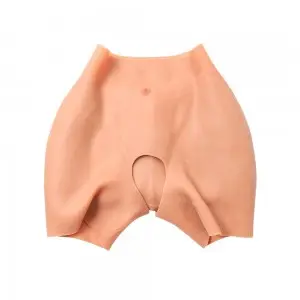
Taking the global market as an example, Google search data shows that in the past year, searches for keywords such as “buttock lifting” and “waist-to-hip ratio optimization” have increased by over 60% year-on-year, far exceeding the search growth rate of “full-body shaping.” Behind this is consumers’ pursuit of “proportionate beauty”: the “flat buttocks” caused by prolonged sitting, the “hip dips” of an H-shaped figure—these pain points that traditional shaping pants struggle to address are precisely where silicone buttock pads focus their efforts. As described in Abstract 4, the medical-grade silicone material is “soft and supple like natural buttock flesh,” with a teardrop-shaped curve that conforms to the curves of the buttocks, precisely filling in depressions to achieve a “3cm increase in hip line” effect—this “targeted” shaping is more in line with today’s consumers’ pursuit of “natural beauty” than the “whole-body tightness” of traditional shaping pants.
More importantly, the value proposition of the global shaping market has undergone a fundamental shift. Abstract 6 points out that the shapewear category is shifting from “slimming” to “smoothing, firming, and sculpting,” with the core being “body optimization without sacrificing comfort.” Traditional shaping pants often cause “wearing fatigue” due to their tightness, while the “no foreign body sensation” characteristic of silicone buttock pads (Abstract 4) perfectly matches this trend—it does not rely on fabric compression but achieves shaping through the material’s own conformity, and can even be worn for extended periods without affecting activity; this is an experience upgrade that traditional categories cannot achieve.
II. A Revolution in Scenario Design: From “Inner Wear Material” to “Social Asset,” Breaking Scenario Boundaries
The limitations of traditional shaping pants in terms of specific scenarios have long been a bottleneck restricting their market expansion. Whether it’s the short tummy control pants mentioned in Summary 1 or regular sharkskin pants, most are defined as “inner wear” or “sports-only”—they easily leave marks when worn as outerwear, have a stiff fit, and are difficult to adapt to everyday social situations. The emergence of silicone hip pads has completely shattered the perception that “shaping products can only be worn innerwear,” becoming a portable “social body shaping tool.”
From the perspective of consumer scenarios in the European and American markets, silicone hip pads have covered multiple needs: * **Everyday Wear:** When paired with jeans or tight skirts, they can invisibly fill the hip contour, avoiding the embarrassment of a “flat buttocks appearing wider.” The “no visible traces” characteristic mentioned in Summary 1 makes it an “invisible body optimizer.” * **Special Occasions:** In occasions requiring sophisticated attire, such as evening parties and banquets, silicone hip pads can quickly improve the waist-to-hip ratio, creating an “S-curve” silhouette when paired with formal wear, without relying on heavy shaping garments. * **Sports Scenarios:** Some silicone hip pads use breathable silicone material (Summary 3), reducing friction on the buttocks when paired with sports pants while providing slight support, balancing functionality and shaping effects.
This “all-scenario adaptability” has upgraded silicone hip pads from “functional consumables” to “social assets”—consumers no longer see them as “necessities” but rather as “a bonus that enhances the overall look.” In contrast, the limited scenarios for traditional shaping pants make it difficult to penetrate broader consumer needs, naturally limiting the market’s potential.
III. Product Breakthrough: Materials, Customization, and Durability Reconstruct the Value of Shaping Products
If iterative demand is the “right time,” and the revolution in scenarios is the “right place,” then the product advantage of silicone hip pads is the “right people” that allows them to break through the traditional market. Compared to traditional shaping pants, the breakthroughs in materials, customization, and durability of silicone hip pads have completely reconstructed the value standards of shaping products.
1. Materials: From “Compression-Type” to “Bionic”
Traditional shaping pants rely on the elasticity of nylon and spandex to achieve “physical compression,” which can easily lead to poor blood circulation with prolonged wear, and the fabric is also stuffy and not breathable. Silicone hip pads, on the other hand, use medical-grade silicone (Abstract 4) and food-grade silicone (Abstract 2), which are essentially “bionic materials”—the feel is close to human muscle tissue (Abstract 3 “imitate the look and feel of human flesh”), conforming to the body without compression, while also possessing excellent breathability, solving the industry pain point of “shaping inevitably causing sweating.”
2. Customization: From “Standardization” to “Personalization” Traditional shaping pants are mostly categorized by “size,” making it difficult to adapt to the needs of different body types (such as pear-shaped and apple-shaped figures), and the color options are limited (mostly skin tone and black), failing to meet diverse styling needs. Silicone hip pads, however, offer customization capabilities that almost cover the personalized demands of consumers worldwide:
Body Shape Customization:Thickness (e.g., 1.2cm thin, 3cm thick, summary 3) and shape (teardrop, round, summary 4) can be adjusted according to hip circumference and hip width to accommodate different issues such as flat hips and sunken hips;
Color Customization:In addition to standard skin tones, darker colors and tan shades are also available to meet the needs of consumers with different skin tones, compensating for the lack of dark-colored options in traditional shaping pants (summary 6);
Function Customization:Some manufacturers offer “removable silicone pads” (summary 2), allowing consumers to add or remove them freely according to the occasion, offering far greater flexibility than traditional one-piece shaping pants.
3. Durability: From “High-Frequency Replacement” to “Long-Term Use” One of the shortcomings of traditional shaping pants is their “poor durability”—the fabric’s elasticity easily diminishes, the edges tend to curl, and the average lifespan is only 3-6 months, requiring frequent replacement. Silicone hip pads, on the other hand, are considered the “industry benchmark” for durability: Abstract 2 mentions that some products have a “three-year lifespan.” Silicone material is wear-resistant and deformation-resistant, and even with long-term use, it is not prone to aging, offering a much higher cost-performance ratio than traditional shaping pants.
IV. Market Access Innovation: Low MOQ + Wide Price Range, Activating the Enthusiasm of Global Small and Medium-Sized Sellers The market expansion of traditional shaping pants has long been limited by “high entry barriers.” On the one hand, the success rate of traditional underwear manufacturers transitioning to shaping pants is less than 30% (Abstract 1). The core reason is that their production relies on large-scale orders, with generally high MOQs (Minimum Order Quantity) (mostly over 500 pieces). On the other hand, their price range is concentrated (e.g., the shaping pants in Abstract 1 are mostly priced between 20-100 yuan), making it difficult to cover the needs of different global markets (such as the low-price demand in Southeast Asia and the high-end demand in Europe and America).
The “low MOQ + wide price range” characteristics of silicone butt pads have significantly lowered the entry barrier to the global market, stimulating the enthusiasm of small and medium-sized sellers:
Low MOQ Advantage: Data from cross-border platforms such as Alibaba and Made-in-China (Summaries 2, 3, 5) shows that the MOQ of silicone butt pads can be as low as 1 piece (retail trial order), 5 pieces (small batch customization), or even 100 pieces to start customized production—meaning that small and medium-sized sellers in emerging markets such as Southeast Asia and Latin America can enter the shaping market without bearing high inventory pressure;
Wide Price Range Coverage: The price range of silicone butt pads ranges from $2.2 (basic model, Summary 2) to over $100 (high-end customized model, Summary 3), perfectly adapting to different market levels:
Emerging Markets (such as India and Vietnam): Choose the $2-$5 basic model to meet the demand for “affordable shaping”;
Mature Markets in Europe and America: Choose the $50-$100 customized model (such as with breathable layer and antibacterial function) to meet the demand for “high-quality shaping”. This “low barrier to entry + broad coverage” market characteristic allows the silicone buttock pad supply chain to rapidly penetrate global markets, especially small and medium-sized markets that traditional shaping pants struggle to reach, further expanding its market reach.
Conclusion: Silicone buttock pads are not just “substitutes,” but also “market expanders.” While traditional shaping pants are still struggling with “price wars” and “style imitation,” the rise of silicone buttock pads is not essentially about “replacing the traditional market,” but rather “creating new market demand”—it targets the needs of “precise shaping,” “all-scenario adaptation,” and “personalized customization” that traditional categories haven’t covered. Through product breakthroughs and market access innovation, it is making the global shaping market pie bigger.
From a global perspective, with the consumption upgrade in emerging markets and the pursuit of “inclusive shaping” in European and American markets, the market potential of silicone buttock pads will continue to be released.
Post time: Dec-24-2025