
Silicone Breast Forms Wholesale: Materials, Cup Sizing and Private Label Options
Silicone breast forms are not one product. A distributor supplying post-mastectomy care clinics is buying a different item from a crossdresser e-commerce brand, even when both arrive as the same teardrop shape in the same skin tone and the same carton. Material grade, back construction, weight, adhesive backing and retail packaging all shift with the end channel. Get one variable wrong and the cost resurfaces later as returns, customs questions, or a product that photographs beautifully but feels wrong the moment a customer opens the pouch. This guide covers the sourcing decisions that actually move margin for importers, private-label brands and adult-retail chains buying silicone breast forms at volume.
Reayoung Underwear, based in Yiwu, moulds breast forms alongside silicone bodysuits, shapers, masks, muscle suits and reborn dolls, so tooling, colour matching and skin-tone pigmentation sit in-house rather than being subcontracted to a third party. For a buyer assembling a skin-contact silicone range, that single-source capability keeps shade and finish consistent from one category to the next.
Which Channels Buy Breast Forms, and What Each One Actually Needs
Before quoting material or cup sizing, confirm the channel. Four buying groups drive most volume, and each one weights the specification differently.
Post-mastectomy and medical-care distribution
Mastectomy boutiques, prosthesis fitters, hospital procurement and home-care distributors buy for comfort under clothing, weight balance against a remaining breast, and skin tolerance during long wear. They care about platinum-cure silicone because residual curing agents stay low and odour is minimal. They care about symmetrical pairs sized to match a real remaining breast, and about documentation that supports a claim of safe prolonged skin contact. They rarely chase the lowest unit price; they chase a stable, repeatable specification that will not generate complaints from fitters. Expect size runs, neutral cartons, and often a SKU list mapped to cup and weight rather than to fashion colours.
Crossdresser, transgender and transformation brands
This is the most design-led channel. Buyers want realistic nipple and areola detail, a spread of darker and lighter skin tones, self-adhesive backing so forms can be worn without a pocket bra, and sizes that create a clear silhouette shift under everyday clothing. Volume concentrates in the mid cups, but both the small and the large ends move steadily and should not be cut from a first range. Packaging here is retail-facing: printed pouches, care cards and discreet outer cartons.
Stage, film, photography and cosplay
Professional and semi-professional buyers order in smaller runs but with tight tolerances. Colour must match under studio lighting, edges must blend, and the form has to survive repeated application and removal. Adhesive performance and edge blending matter more than all-day wear comfort, because the piece is off between takes and re-applied the next morning.
Aesthetic enhancement and specialty retail
A smaller but profitable segment: buyers who want a fuller silhouette under formal wear, bridal, swim or stage costume. Orders are fragmented and unit volumes low, so this channel suits a distributor who can break bulk from a master carton rather than a factory selling direct to consumers.
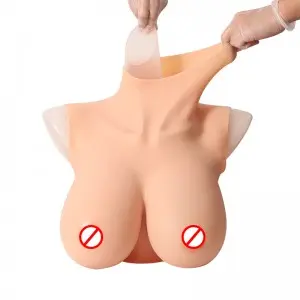
Material Grades: Platinum-Cure versus Tin-Cure Silicone
Almost every technical question about breast forms comes back to cure chemistry, because it drives hand feel, service life and how confidently you can describe the product to a regulated buyer.
- Platinum-cure (addition-cure) silicone: catalysed with platinum, produces no meaningful by-products, holds colour and clarity well, resists yellowing, and usually delivers a softer, more skin-like drape. This is the default choice for skin-contact and medical-adjacent lines.
- Tin-cure (condensation-cure) silicone: cheaper per kilogram and faster to process, but it can continue to release by-products, may shrink slightly over time, and tends to feel firmer and less forgiving. Reasonable for props and short-life novelty items, not for long-wear skin contact.
The practical difference for a buyer is service life and complaint rate. Tin-cure units pressed against skin for hours can develop odour and surface tack, which turns directly into returns and chargebacks. For any channel where the form is worn against skin for extended periods, specify platinum-cure and expect a higher material cost that is normally recovered through a lower return rate.
Medical grade versus general purpose silicone
Medical grade is a claim backed by documentation, not a marketing adjective. It depends on what the supplier can actually show: biocompatibility testing, extractables data and a stated manufacturing environment. Plenty of factories produce excellent skin-contact silicone that is not certified medical grade, and that is entirely appropriate for crossdresser, costume and general retail channels. Be precise about which claim your packaging and product page will make, then match material and paperwork to that claim before you commit to a print run.
Shore hardness and hand feel
Density and softness are separate settings, and buyers routinely conflate them. Softness is expressed on the Shore hardness scale, and breast forms sit in a soft range where small increments are noticeable to the touch. Two forms of identical weight can feel completely different: one gel-like and fluid, another firm and structured. Ask for physical samples at the hardness you intend to sell and test them under clothing, not only in the hand. For gel-core constructions, also confirm shell thickness, because a thin shell reads as more realistic but punctures more easily in transit and in use.
Construction: Layers, Back Cavity and Adhesive Systems
Two forms with the same cup and colour can be built in fundamentally different ways. Construction decides how the form sits on the chest, how it moves, and what it costs to make.
Single layer versus dual layer
A single-layer form is one moulded silicone body: simple, durable and uniform in feel throughout. A dual-layer form pairs a soft gel or low-hardness core with a tougher outer skin, giving a more natural drape and better tear resistance at the edges. Dual-layer builds cost more and demand tighter process control, but they are what most premium skin-contact lines use, and they are the version that survives a customer’s first six months of wear.
Back cavity: full back versus half back
The back cavity determines fit. A full-back concave design cups the natural chest or a remaining breast and spreads weight across a wider area, which is generally better for extended wear and for balancing against a natural breast. A half-back or shallow form is lighter, quicker to position and preferred where the wearer wants a fast change or is layering under close-fitting garments. Carry both if your channel mix spans medical and fashion.
Adhesive backing versus smooth back
Self-adhesive backs, usually a skin-safe adhesive layer or a reusable adhesive film, let the form be worn without a pocket bra. They suit crossdresser and fashion channels and support a clear price premium. The trade-off is maintenance: adhesive picks up lint and body oils and needs cleaning to stay tacky. Ship the correct care instructions with every order or you will absorb avoidable complaints. Smooth-back forms rely on a pocket bra or tape, last longer with less user error, and are the safer first SKU.
Microbead or cotton filled versus solid silicone
Filled forms use lightweight microbeads or fibre fill inside a silicone shell. They cut shipping weight and unit cost dramatically and feel comfortable in hot climates, but they do not drape or move like solid silicone and can feel noticeably lighter than a natural breast. Solid silicone forms are heavier, more realistic in motion, and usually the choice where weight balance matters. Decide per channel rather than per factory: lightweight for fashion and warm-weather markets, solid for medical and realism-driven purchases.
Cup Sizing, Symmetry and Weight Options
Sizing is where wholesale breast form orders most often go wrong, because cup letter, volume and weight are three separate scales that suppliers sometimes quote interchangeably.
- Cup range: a full line typically runs from AA through K, with the deepest stock depth in the B to E band. New buyers should start with a narrow, high-velocity core and expand only after sell-through data arrives.
- Symmetry: symmetrical teardrop or oval forms suit general wear and can be rotated for even wear. Asymmetric forms are shaped to mirror a specific side and are used to match a remaining breast after unilateral surgery.
- Weight classes: the same cup is often offered in lightweight and standard weight versions, and sometimes a heavier full-weight build. Weight, not cup, drives how the product behaves under clothing.
- Volume versus weight: volume is geometry; weight depends on material density and whether the core is filled or solid. Specify both, and ask for actual grams per pair rather than inferring from the cup letter.
Because weight and volume interact with garment fit, request a pair-level measurement sheet in grams and millimetres and attach it to the approved specification. That one document prevents most size disputes on repeat orders and gives your customer service team something factual to quote.
Private Label and Custom Development
Private label in this category means more than printing a logo on a pouch. It usually touches three areas: the mould, the surface detail and the retail presentation.
- Tooling and moulds: a private label tooling programme starts with your target cup, projection and back profile. If the factory already holds a mould close to your spec, you avoid tooling cost entirely and customise only surface detail and colour. New moulds carry a one-time charge that is best negotiated as an amortisation credit against committed volume.
- Skin tone matching: supply a physical reference such as a swatch, a chip or a competitor sample, never a screen colour. Silicone pigments shift under different lighting, and translucent skin tones are the hardest of all to match consistently from batch to batch.
- Areola and nipple detail: options run from a simple darkened disc to multi-tone hand-detailed areolas with textured nipple surfaces. Hand detail raises unit cost and adds labour time, so reserve it for channels that photograph and sell the product close-up.
- Packaging and instructions: printed care cards, poly pouches, rigid boxes and multilingual inserts are all achievable. Make sure the claims printed on the insert match the material documentation you actually hold.
Compliance and Safety Questions Buyers Should Ask
Regulatory exposure in this category sits in two places: skin-contact material restrictions, and marketing claims. Both move over time, so confirm the current position with your testing lab and your importer of record before anything goes to print.
- REACH and restricted substances: for the EU market, skin-contact articles are expected to respect restrictions on phthalates and heavy metals. Ask for a test report tied to the specific production lot, not a general certificate from a previous year.
- Skin-contact suitability: request extractables and skin-sensitisation data where the factory has it, and confirm the material’s stated maximum continuous contact time before you write a wear claim on the pack.
- Medical claims: describing a product as a prosthesis or a medical device carries obligations that vary by market. If your channel does not support those obligations, sell it as a cosmetic or novelty silicone form and keep the wording clean. Where classification is genuinely unclear, treat the latest published guidance as controlling.
- Adhesive and powder: any adhesive layer or dusting powder contacts skin directly and should be documented to the same standard as the main body.
The practical discipline is simple: build a specification file per SKU that pairs material, hardness, weight and the supporting test documents, and refresh it whenever you change supplier, mould or colour.
Tip: Ask every candidate supplier for a lot-specific REACH and phthalate test report plus a physical sample at the exact hardness you intend to sell, because a general certificate and a soft sample pulled from a different batch hide the two failure points that generate the most returns.
Cleaning, Care and Expected Service Life
Care guidance affects both return rates and repeat purchase behaviour, so it is worth specifying rather than leaving to the buyer to improvise.
- Cleaning: mild soap and lukewarm water, or a pH-neutral silicone cleanser. Avoid alcohol, solvents and oil-based products, which degrade silicone surfaces and break down adhesive layers.
- Adhesive maintenance: rinse the adhesive surface, air dry fully, and refresh tack with a dedicated adhesive renewer where the construction supports it.
- Anti-stick powder: a light dusting of cosmetic-grade powder reduces surface tack during storage and helps forms slide into garments without grabbing.
- Storage: keep forms in a rigid tray or the original moulded shell, away from heat, direct sun and sharp objects. Creases from folded storage become permanent pressure marks.
- Replacement cycles: with correct care, a platinum-cure form holds shape and colour far longer than a tin-cure unit; wear frequency, adhesive use and sun exposure are the real drivers. Avoid quoting a fixed lifespan unless your material supplier actually supports it in writing.
MOQ, Sampling and Lead Times
Order structure here is less rigid than in cut-and-sew apparel, because stock moulds and stock skin tones carry far less setup cost than new tooling.
- Stock specifications: lowest MOQ. You choose from existing cups, colours and back types, and the only customisation is usually packaging and labelling.
- Custom colour or surface detail: mid-tier MOQ, because pigment batches and hand detailing have minimum run sizes that do not scale down further.
- New mould: the highest commitment, with a one-time tooling fee that is best negotiated as a credit against a volume target rather than accepted as sunk cost.
- Sampling: always request pre-production samples in the final colour and hardness, approve them in writing, and keep a sealed golden sample at the factory.
- Lead times: stock orders ship fastest; custom colour and mould work add production and sample-approval time. Build the approval loop into your launch calendar instead of assuming a fixed number of days.
Price ladders typically step at a small trial quantity, a mid volume and a container-level tier. Ask for the ladder in writing before you commit, and confirm in advance what happens if you land just short of a tier.
Packaging, Privacy and Shipping
Discreet presentation is a genuine commercial requirement in this category, not a nicety.
- Discreet shipping: plain outer cartons with neutral or generic labelling, no product description on the outside, and no branded tape that signals the contents to anyone handling the parcel.
- Protection: forms deform under sustained pressure, so specify moulded trays, foam inserts or individual poly bags inside a rigid carton. Do not let a full container compress the top layers.
- Sea versus air: sea freight suits heavy solid silicone and container-level orders; air freight suits lightweight filled forms, urgent replenishment and sample shipments where speed outweighs freight cost.
- Customs and clearance: provide accurate descriptions, classification and material composition, and keep test documents accessible to your broker. Vague descriptions on a skin-contact novelty item invite inspection delays.
FAQ
What is the difference between a silicone breast form and a silicone filler bra?
A breast form is a standalone moulded silicone unit worn in a pocket bra or with an adhesive back, shaped to replace or supplement breast volume. A filler or enhancement insert is typically lighter, thinner and designed to sit inside a bra cup for shape rather than to carry weight or match a breast. They serve different customers and usually sit at different price points, which is why they should be separate SKUs in your catalogue.
Can I order breast forms in my own skin tone and packaging?
Yes. Colour matching and packaging are the two most common private-label requests. Provide a physical colour reference, approve a pre-production sample, and confirm printed claims against your test documentation. New moulds are optional and only needed if you require a projection or back profile the factory does not already hold.
Is platinum-cure silicone always the right choice?
For long-wear skin contact and medical-adjacent channels, yes. For props, costume and short-duration novelty use, tin-cure can be an acceptable cost saving. Decide based on wear duration and your returns tolerance, not on unit price alone.
Do I need medical certification to sell breast forms?
Only if you intend to market them as medical devices or prostheses, which carries market-specific obligations. Many successful sellers position silicone forms as cosmetic or personal-care products. Confirm current requirements for your destination market before printing packaging or running advertising.
How many sizes should a first order cover?
Start narrower than you think. A core band of the most requested cups and one or two skin tones, in both a lightweight and a standard weight version, will tell you more in one season than a full AA-to-K run. Expand once you have sell-through data in hand.
Related Pages
- Different Types of Silicone Nipple Covers Explained for Buyers
- What Is a Silicone Nipple Cover? A Guide for Wholesale Buyers
- Why Private Label Silicone Nipple Covers Are a Profitable Opportunity
- Top Reasons Retailers Should Add Silicone Nipple Covers to Their Portfolio
Post time: Oct-14-2026