
Silicone Crossdresser Products Wholesale: A Complete Sourcing Guide for Adult Retailers
For buyers operating adult retail storefronts, cross-dressing specialty shops, and transgender-community supply channels, the silicone crossdresser products category has become a steady, repeat-purchase segment that sits outside the seasonal volatility of fashion apparel. This guide is written from a procurement engineering perspective: it focuses on material safety, dimensional specification, manufacturing economics, and compliance, so that importers and brand owners can build a defensible sourcing plan rather than relying on catalogue guesswork.
1. Target Market Overview: Demand from Cross-Dressing Communities and Transgender Consumers
The demand base for silicone transformation products is broader and more durable than casual observers assume. The core purchasing groups are adult cross-dressers seeking temporary physical silhouette adjustment, transgender women and non-binary individuals who use forms and padding as part of daily gender expression, and costume or performance users who require realistic prosthetics for stage, film, or event work. From a B2B standpoint, these buyers share three consistent behaviors: they repurchase adhesives and accessories on a fixed cycle, they research material safety before buying, and they are highly sensitive to discreet logistics.
Retailers serving this segment should treat the category as a technical accessory line, comparable to orthopedic padding or theatrical prosthetics, rather than as novelty merchandise. Conversion rates improve when product pages state concrete parameters: material grade, weight in grams, shore hardness, and wash-cycle ratings. Buyers in this niche read specifications closely and will abandon a listing that omits them.
Procurement Implications for Retail Buyers
- The category supports subscription-style reordering of adhesives, cleansers, and tapes, which stabilizes lifetime customer value.
- Educational content about fitting and skin safety outperforms lifestyle imagery for driving qualified traffic.
- Inventory should be stratified by size and skin-tone shade rather than by single universal SKUs.
2. Product Family: A Specification Map of Silicone Transformation Items
A complete wholesale programme typically spans five product lines, each with its own measurement logic and quality-control checklist. The silicone breast forms line is the highest-velocity entry product, followed by bodysuits, hip and pelvis pads, realistic masks, and muscle suits. Understanding where each product sits in the fit stack helps buyers avoid overlapping SKUs and margin leakage.
Breast Forms
Self-contained prosthetics worn inside a bra cup or adhered to the chest wall. Primary variables are cup size, volume in millilitres, mass in grams, and shore hardness (typically 00-20 to 00-35 for a skin-like feel).
Bodysuits
Full-torso or full-body garments that redistribute silhouette contour. Specified by thickness in millimetres, neck-line design, and seam construction. The silicone bodysuit is the most capital-intensive SKU to tool and therefore carries the highest per-unit margin when MOQ is met.
Hip and Pelvis Pads
Localized padding for hip width and pelvic contour. Sold as pairs, rated by width extension in centimetres and by adherence method.
Realistic Masks
Full or three-quarter face prosthetics. Distinguished by ear-to-ear fit, neck-flap length, and hand-painted detail density. The silicone realistic mask line is the most labor-intensive to finish and is usually offered as a made-to-order tier rather than stock goods.
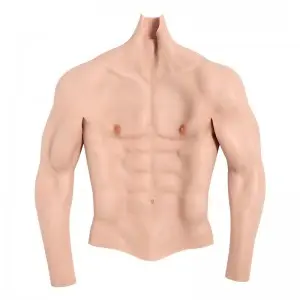
Muscle Suits
Male-physique padding simulating chest, shoulder, and limb volume. Specified by muscle-group coverage and overall added mass.
3. Platinum-Cure vs Tin-Cure Silicone: Skin-Contact Safety Differences
The single most important technical decision in this category is the cure chemistry of the silicone. Platinum-cure (addition-cure) silicone uses a platinum catalyst and produces no byproducts during crosslinking. It is inert, odorless, and classified as skin-safe for prolonged contact when formulated to cosmetic-grade standards. Tin-cure (condensation-cure) silicone uses a tin-based catalyst and can release trace byproducts, including low levels of volatile siloxanes, during and after curing. For products that sit against bare skin for hours, platinum-cure is the procurement default.
From a sourcing standpoint, platinum-cure material costs more per kilogram and requires tighter process control, but it removes a major liability vector for adult retailers. Buyers should require a material declaration stating cure type and, where relevant, a third-party extractables report. Tin-cure may still be acceptable for fully encapsulated or non-contact costume pieces, but it should never be the default for breast forms, masks, or bodysuits worn against skin.
Tip: Always request the cure chemistry in writing and reject mixed-cure claims that do not specify platinum content per batch.
4. Breast Form Sizing: Cup, Volume, Weight, and Wear Method
Breast form sizing does not map cleanly onto clothing cup letters alone, because the same cup letter can imply different volumes across bra brands. A robust wholesale specification should capture three independent parameters: nominal cup size (A through G or beyond), volume in millilitres (typically 120 ml for an A up to 900 ml or more for a G), and mass in grams, which determines wearer comfort and the required garment support.
Adhesive Wear vs Pocket Wear
- Adhesive (self-adhering) forms carry a medical-grade silicone tack layer and bond directly to the chest wall for a seamless neckline; they require skin-safe adhesive refills and daily cleansing.
- Pocket forms slide into a bra with a built-in pocket and are preferred by buyers who rotate multiple forms or who avoid skin adhesives for sensitivity reasons.
- Variant forms include partial forms for post-surgical or asymmetry use and swim forms rated for chlorinated water.
Buyers should stock both wear types, because the choice is frequently driven by skin condition and lifestyle rather than by price. Weight tolerance should be held within plus or minus five percent per pair to keep balance symmetrical.
5. Bodysuit Thickness Selection and Neck-Face Transition Design
Bodysuit thickness is the primary driver of both realism and durability. Common wholesale thicknesses run from 0.4 mm to 1.2 mm. A 0.4 mm to 0.6 mm suit is lighter and more breathable but tears more easily at stress points. A 0.8 mm to 1.0 mm suit balances wear life with a natural drape. A 1.2 mm suit is the most durable and best for repeated professional use, at the cost of added heat retention and higher material weight.
Neck and Facial Connection Design
The visual failure point of most bodysuits is the junction at the neck and jaw. Two construction approaches dominate: a roll-down collar that tucks under clothing, and a contoured neck-flap that blends into the wearer’s own skin with makeup. For buyers targeting cross-dressing users specifically, the contoured flap with a feather-edged transition reduces the visible seam line and is worth the added finishing cost. Seam placement should avoid the centre front and shoulder lines where tension is highest.
6. Realistic Mask Fit: Facial Conformity, Neck Transition, and Hand Painting
A realistic mask lives or dies on three details. Facial conformity means the mask must follow the wearer’s bone structure closely enough that expression does not create gaping at the cheek and temple. Suppliers achieve this through multi-size scalp mapping (usually small, medium, large, plus an XL for broader jaw lines) and, for premium tiers, custom casting from a life mask.
The neck transition is the second detail. A mask that ends abruptly at the jaw reads as a costume, while a mask with a tapered neck flap that disappears under a collar reads as seamless. Hand painting is the third. Automated airbrush bases establish skin tone, but手工 (hand-applied) veining, freckle scatter, and lip gradient are what justify a premium price tier. Buyers should request close-up photographs of the painted edge work before committing to a production run, because painting consistency is the hardest quality attribute to hold across batches.
7. Privacy Packaging and Unmarked Shipping for Adult Retail
Discretion is not a value-added extra in this category; it is a baseline requirement. Adult retailers lose customers permanently when a parcel arrives with identifiable branding or product names on the exterior. The procurement specification should state: plain outer carton with no product description, neutral shipper as sender, internal void-fill that does not reveal contents, and a packing slip that carries only a generic SKU reference.
For wholesale buyers who operate their own fulfilment, the factory should support blind-drop shipping with the retailer’s own return address and a neutral invoice that omits sensitive item names. This protects both the end consumer and the retailer’s brand equity in conservative markets.
8. REACH Compliance and Phthalate Limits
For any silicone item destined for the European market, REACH compliance is non-negotiable. The relevant concern for soft PVC-adjacent accessories and some blended elastomers is phthalate plasticizer content. Restricted substances under Annex XVII include DEHP, DBP, BBP, DINP, DIDP, and DNOP, with a combined limit of 0.1 percent by weight for articles placed on the EU market. Platinum-cure silicone that contains no plasticizer is inherently outside this risk, but buyers should still obtain a declaration of conformity and, for blended or coated items, a test report from an accredited laboratory.
Beyond REACH, retailers shipping to California should be aware of Prop 65 listing thresholds for certain chemicals, and buyers serving the UK must verify UK REACH alignment post-transition. A single compliance document set per product family, refreshed annually, is sufficient for most importers and significantly reduces customs friction.
9. Mold Fees, MOQ, and the Private Label Process
The economics of silicone transformation products are dominated by tooling. A new breast form shape requires a master sculpture and a production mold, typically billed as a one-time mold fee ranging from a few hundred to over a thousand US dollars depending on complexity and size count. Bodysuits and masks carry the highest mold investment because of their surface area and detail requirements.
Standard Private Label Workflow
- Select a base shape from the supplier catalogue or commission a custom master sculpture with reference measurements.
- Confirm skin-tone shade range, shore hardness, and any logo or packaging customization.
- Pay the mold fee and approve a pre-production sample before mass tooling.
- Place the production order against the agreed MOQ, commonly 100 to 300 units per SKU for forms and lower for bodysuits.
- Receive bulk goods with compliant documentation and neutral packing.
Buyers should negotiate mold ownership and clarify whether the mold fee is a one-time charge or amortized across the first order. Retaining mold ownership protects the buyer if they later switch suppliers. Lead time for first production typically runs six to ten weeks including sampling, so forecast accordingly.
10. Platform and Payment Channel Restrictions for Adult Categories
The adult classification of these products creates real friction that procurement plans must absorb. Major marketplaces such as Amazon and certain social commerce platforms restrict or prohibit listings that depict body-transforming adult items, even when described technically. Sellers therefore concentrate on independent storefronts, niche community marketplaces, and specialized adult retail aggregators.
Payment processing is the second constraint. Mainstream processors may flag or freeze accounts in this category, so retailers commonly use processors with explicit adult-category policies and maintain reserve buffers for chargeback exposure. Buyers building a wholesale programme should confirm that their supplier can issue commercial invoices acceptable to their processor and that product descriptions on customs documents use neutral, defensible terminology. Building the channel before scaling inventory prevents stranded stock when a processor policy shifts.
Frequently Asked Questions
Is platinum-cure silicone necessary for all products in this category?
For any item worn directly against bare skin for extended periods, platinum-cure is the recommended standard because it is inert and odorless. Tin-cure may be considered only for fully encapsulated costume pieces with no skin contact.
What MOQ should a new retailer expect?
Breast forms commonly start at 100 to 300 units per SKU, while bodysuits and realistic masks often begin at lower quantities due to higher per-unit value. Custom mold programmes usually require a first-order commitment that covers the tooling cost.
How should skin-tone shades be managed in inventory?
Stock a stratified shade range rather than a single universal tone, and track shade velocity separately. Most retailers find that three to five core shades cover the majority of demand, with custom blending reserved for made-to-order tiers.
What documentation is required for EU import?
A REACH declaration of conformity, a phthalate test report for any blended or coated components, and a material safety data sheet where applicable. Platinum-cure silicone items generally pass screening provided the supplier issues the correct declarations.
Can the factory ship directly to my customers discreetly?
Yes, provided the procurement specification requires plain cartons, neutral sender details, and generic packing slips. Confirm blind-drop capability and return-address handling before launch.
Related Pages
- Different Types of Silicone Nipple Covers Explained for Buyers
- What Is a Silicone Nipple Cover? A Guide for Wholesale Buyers
- Why Private Label Silicone Nipple Covers Are a Profitable Opportunity
- Top Reasons Retailers Should Add Silicone Nipple Covers to Their Portfolio
Ready to source silicone crossdresser products with compliant documentation and discreet logistics for your retail programme?
Post time: Oct-09-2026