
Silicone Bodysuits: Thickness, Sizing and Quality Checks for B2B Buyers
For procurement teams handling adult novelty distribution, film and theater prop supply, crossdressing and cosplay channels, cross-border e-commerce, and private label programs, a silicone bodysuit behaves unlike any textile garment in the existing assortment. It does not stretch by yarn elasticity alone, it does not recover after washing in the way a knit does, and its cost structure is driven by material volume rather than by sewing minutes. This guide is written for buyers who already move silicone products and now need to specify, sample, and inspect a full-body garment with repeatable results.
The focus here is engineering and inspection: how silicone thickness translates into wear behavior and landed cost, how size systems are mapped and graded, which material parameters belong in a request for quotation, and how defects are judged at incoming inspection. Sourcing channel economics and consumer trend commentary are deliberately left out.
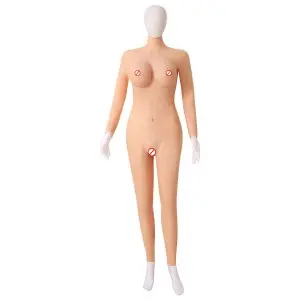
1. Product Forms and Channel Positioning
A bodysuit program is rarely a single SKU. Before requesting quotations, decide which construction the channel actually needs, because the tooling, lead time, and unit price diverge sharply between them.
- Full bodysuit, closed crotch: covers torso, arms, and legs. Heaviest material consumption and the highest unit cost, but gives the continuous skin effect that film, photography, and high-end crossdressing channels expect.
- Half-body suit (torso to waist or hip): used where legs are covered separately or where the design pairs with hosiery. Lower weight, easier donning, better entry price point for marketplace sellers.
- With integrated breast forms: chest volume molded into the same shell, giving seamless transition without visible seams or insert pockets. Requires additional sizing dimensions and makes size returns more expensive.
- Without chest filling: hollow or flat chest cavity designed to accept separate silicone breast forms. Keeps the shell size run simple and lets retailers sell forms as attach-on SKUs.
- Entry structures: back zipper, front zipper, crotch zipper, shoulder openings, or a pure step-in neck stretch entry with no hardware. Zippers improve donning for heavier gauges but introduce a failure point at the tape-to-silicone bond.
Channel logic follows form. Cross-border marketplace sellers usually start with unlined half-body suits because the price point converts and returns are manageable. Specialty crossdressing retailers tend to request integrated chest options and neck-entry designs. Prop houses care most about seam placement being invisible on camera and often accept cosmetic compromises elsewhere.
2. Silicone Thickness: Ranges and Trade-offs
Silicone thickness is the single specification that drives almost everything downstream. Thin shells drape and conform; thick shells hold shape and hide body detail but add kilograms of material and shipping weight.
- Ultra-thin, roughly 0.8 to 1.5 mm: maximum conformity and the lightest garment. Reads well on camera and feels closest to a second skin, but tear initiation at fingers and nails is the dominant failure mode and repair is difficult.
- Standard, roughly 2 to 3 mm: the general-purpose band for most wholesale programs. Balances drape, opacity, and handling durability. Depending on base hardness this is usually the default recommendation for first orders.
- Heavy, roughly 4 to 6 mm: substantial figure reshaping and high opacity, used for torso sculpting effects and for prop applications with repeated rigging. The wearer will perceive noticeably more thermal load and reduced mobility.
- Zoned construction: thicker panels over abdomen and thighs, thinner gauges at underarm, elbow, knee, and crotch where flexion occurs. This costs more in process control but is usually how an experienced silicone garment manufacturer resolves the durability-versus-comfort conflict.
Three consequences deserve explicit attention in your sourcing notes. First, material cost scales close to linearly with average gauge, so moving from 2 mm to 3 mm is a significant per-unit increase, not a marginal one. Second, carton weight grows in parallel, which affects both air freight quotes and the volumetric billing that cross-border sellers watch closely. Third, thicker does not automatically mean stronger: a thick section in a low-tear-strength formulation will still fail at a stress concentrator, whereas a well-formulated thin sheet can outperform it.
Tip: specify thickness as a tolerance band measured at defined check points rather than as a single nominal number, because dipped and coated production naturally varies across a large shell.
3. Size Systems and Pattern Development
Silicone does not have the give-and-take of spandex, so a size run that works for knit shapewear will generate high return rates if copied directly onto a silicone shell. Buyers supplying the United States, Germany, the United Kingdom, France, Japan, and Australia should assume at least two size languages in the same order: alphanumeric (S through 5XL at minimum) and local numeric mapping for European listings.
- Baseline measurements to supply: height band, bust or chest, underbust, natural waist, hip, inseam, arm circumference at bicep, thigh circumference, and neck circumference.
- Grading increments: agree on the step per size in centimeters before sampling begins. Uneven grading across bust and hip is the most common cause of a clean sample turning into a poor production run.
- Custom pattern development: if the brand’s fit block is proprietary, provide the pattern file or a physical reference garment. A custom silicone bodysuit program typically begins with a base block and then applies negative ease derived from the chosen gauge.
- Fit samples and revision: plan for a first trial piece, a wear test report from the buyer side, one revision round, and a confirmed counter sample. Record every revision against a version number so the mold or pattern can be traced.
- Confirm before sign-off: the negative ease value applied, the measurement points used for inspection, and whether the golden sample is the physical piece or a documented specification.
4. Material Parameters to Put in the Specification
A garment quotation that only names “silicone” is not a comparable quotation. Ask the factory to state the following on the quotation sheet or technical file so competing offers can be evaluated against the same baseline.
- Hardness, Shore A: typical garment ranges sit in the very soft band. State the target value with a tolerance, since durometer shifts the perceived drape and how the garment releases from the mold.
- Tear strength: more predictive of field failure than tensile strength for thin sections. Thin designs should carry a higher tear requirement than thick ones.
- Elongation at break: must be high enough to clear the shoulders and hips during donning. Verify against the largest planned size, not the sample size.
- Tensile set and recovery: relevant to neck-entry designs, where repeated stretching over the shoulders can permanently deform the opening.
- Platinum silicone versus standard peroxide-cured systems: platinum addition-cure systems are generally preferred for skin-contact products because they avoid peroxide decomposition by-products and typically show lower odor. They are more sensitive to inhibition from certain contaminants, which raises process-control requirements and cost. If your compliance team requires a specific cure chemistry, state that explicitly.
- Skin-contact documentation: requirements for skin-contact materials, restricted substances, and labeling differ by destination market and are revised over time. Applicable clauses should be confirmed against the latest standard texts and official announcements for each target market rather than assumed from a previous order.
5. Production Processes That Affect Appearance
- Molded or compression-formed panels: consistent wall thickness and good surface definition, suitable for zoned construction and integrated chest volumes. Tooling cost is higher and pattern changes are slower.
- Dipped or brush-coated build-up: lower tooling investment and flexible for small size runs or bespoke pieces. Thickness distribution is less even, which is why the tolerance band discussed above matters here.
- Seam handling: seams are either bonded with compatible silicone to form a continuous joint, or left as visible closures. Bonded seams should be dressed and post-cured so the joint does not read as a ridge under clothing or on camera.
- Edge trimming and flash removal: neck, wrist, ankle, and zipper perimeters need defined finishing. Poor trimming leaves flash that initiates tearing during donning.
- Surface finishing: matte finishing reduces shine under studio lighting and reduces surface tack. Some programs add a light surface treatment to reduce friction; ask that any coating be identified so it can be assessed against your own compliance requirements.
6. Color Matching and Batch Consistency
Skin-tone assortments are where disputes usually begin, because the buyer samples one piece and the shipment contains three hundred. Build the control loop into the purchase agreement instead of negotiating it after arrival.
- Define the tone range: agree on a numbered shade set with physical reference chips rather than descriptive names such as “natural” or “tan,” which resolve differently between teams.
- Batch numbering: every production lot should carry a batch identifier that appears on the inner packaging, enabling later traceability.
- Retained samples: the factory retains a cured sample from each batch, and the buyer retains a reference set. On reorder, compare the new retained piece against the previous one under controlled lighting.
- Lighting condition: specify assessment under neutral daylight-equivalent illumination, because warm retail lighting can hide undertone drift that customers will notice outdoors.
- Acceptance language: agree whether comparison is judged against the physical reference chip, a spectrophotometric tolerance, or visual approval by a named person. Vague language here produces inconsistent claims.
7. Common Defects and Incoming Inspection Criteria
Set defect definitions before the first shipment leaves. Each item below should have an acceptance threshold and a sampling level written into the inspection sheet.
Defect Reference List
- Bubbles and voids: entrapped air visible at or near the surface. Judge by diameter, count per panel, and location; voids at high-flex zones and near seams warrant rejection at a smaller threshold than the same defect on a low-stress area.
- Tears and pinholes: any through-thickness breach is normally a functional reject because it propagates during wear. Check fingers, crotch, and underarm by light transmission against a backlit panel.
- Delamination: separation at bonded seams, at zipper tape interfaces, or between layered build-up coats. Test by applying controlled peel force at seam edges on a sample basis, not by pulling finished stock by hand.
- Oily or tacky surface: surface exudation indicates incomplete curing or formulation imbalance. Record whether it transfers to a clean substrate and whether it persists after cleaning and airing; distinguish this from the designed tack of adhesive contact zones.
- Edge cracking: fine splits at trimmed edges or necklines. Grade by length and depth, and note whether cracking appears only after a donning trial, which usually points to insufficient edge radius rather than material failure.
- Zipper and hardware faults: misalignment, slider catch, or tape lifting. Cycle-test a sample quantity through the full open-close count specified in the order.
- Thickness deviation: measure at the agreed check points and reject outside the tolerance band agreed at sampling stage.
8. Packaging, Discreet Shipping and After-Sales Terms
- Inner packaging: garments should be folded or rolled with interleaving material to prevent self-adhesion in transit, then sealed in an individual pouch. State whether the pouch is opaque and whether any product description appears on it.
- Outer carton neutrality: for distributors and private label clients, cartons are normally specified without supplier identity or product naming. Confirm carton markings, shipping marks, and whether any documentation inside the carton discloses contents.
- Weight and cube: request the packed carton dimensions and gross weight per size mix, since heavy gauges can push parcels into a higher volumetric bracket for marketplace fulfillment.
- After-sales terms: agree the claim window, evidence format for defect claims, and the remedy path, whether that is replacement in the next shipment, credit against a future order, or rework. Also agree responsibility for shipping cost on legitimate quality claims.
- Care instructions: confirm who supplies the insert or label content and in which languages, given different destination requirements.
9. Product Fit Statement: Matching Constructions to Channel Requirements
The following conditions describe typical configurations rather than performance claims, and each line lists the data that must be confirmed with the factory before ordering. A standard wholesale program covering sizes S through 5XL in a 2 to 3 mm average gauge, with zoned thinning at underarm and knee, suits general cross-border and wholesale accounts where carton weight and margin sensitivity dominate. An integrated-chest full bodysuit in the same gauge range suits crossdressing and cosplay retailers whose customers prioritize silhouette continuity; confirm the chest volume-to-shell-size mapping and whether the factory can hold it across the full grading run. For film and prop applications where the garment is rigged and reused across takes, a heavier localized reinforcement at stress points is more relevant than uniform thickness; request the bonding method, the seam cure protocol, and the repair procedure. Entry-level marketplace programs frequently select an unlined half-body style with a back zipper, which requires confirmation of zipper specification, tape bonding method, and cycle-test results. In every case, the three items to close out before payment are the signed golden sample reference, the written thickness tolerance with measurement points, and the defect acceptance thresholds applied at inspection.
Purchasing Checklist and RFQ Elements
What to Include in Your Request for Quotation
- Product form: full or half body, chest filling present or absent, entry structure and zipper specification.
- Thickness: target average gauge, tolerance band, measurement points, and any zoned variation map.
- Material parameters: Shore A hardness with tolerance, minimum tear strength, minimum elongation, cure system whether platinum addition-cure or standard, and any restricted substance documentation required by the destination market.
- Size run: required sizes, market mapping, grading increments, and the measurement set supplied for development.
- Dimensioned drawing or reference: a technical sketch with critical dimensions, and either a physical reference garment or a pattern file.
- Shade set: numbered tones with reference chips, and how batch comparison will be judged.
- Quantity per size and per color, target delivery schedule, and whether this is a first order or a reorder against an existing reference.
- Packaging: inner pouch type, carton neutrality requirements, shipping marks, and care documentation language.
- Inspection: sampling level, defect thresholds per category, and whether third-party inspection is expected.
- Sample plan: number of fit samples, revision rounds allowed, counter sample confirmation method, and sample cost treatment against the bulk order.
FAQ
Frequently Asked Questions from Bulk Buyers
- What minimum thickness should we specify for a first wholesale order? The 2 to 3 mm band is generally the safest starting point because it tolerates normal donning without being prohibitively heavy. Buyers targeting the lowest possible price point often test thinner gauges, but they should request tear strength data for the specific formulation before committing.
- How much size grading data do we need to provide? The measurement list in section 3 is usually sufficient to begin development. If you already sell a fitted textile garment in the same size run, sending a physical sample of that garment often gives better results than a spec sheet alone.
- Can one production run cover several skin tones? Yes, but each tone is a separate color batch and normally carries its own minimum quantity. Ask for per-tone minimums before finalizing the assortment.
- How is silicone bodysuit wholesale pricing usually structured? Quotations are typically driven by average gauge and therefore by material weight, the complexity of the construction such as zoned thickness or integrated chest volumes, tooling requirements for molded forms, size run width, and order quantity per color. Compare offers only after all suppliers quote against the same written specification.
- What should be asked about product safety documentation? Requirements depend on the destination market and are subject to revision. Request the test reports the factory holds, the standards those reports cite, and the test date, then validate applicability against the current standard texts and official announcements for your market. Do not carry over assumptions from a previous season.
- How are reorders kept consistent with the original sample? Retained samples from each batch plus a written reference specification are the practical answer. Reference the batch number and sample version in the purchase order for every repeat order.
- What lead time assumptions should we avoid? Avoid assuming that a first order with new pattern development behaves like a reorder. Tooling, fit samples, revision rounds, and any required testing are sequential steps, and each should appear as a dated milestone in the quotation.
Ready to source a silicone bodysuit program? Send your specs, including target thickness range, size run with measurements, Shore A hardness requirement, and estimated quantity per shade, and Request a Quote today.
Related Pages
- Different Types of Silicone Nipple Covers Explained for Buyers
- What Is a Silicone Nipple Cover? A Guide for Wholesale Buyers
- Why Private Label Silicone Nipple Covers Are a Profitable Opportunity
- Top Reasons Retailers Should Add Silicone Nipple Covers to Their Portfolio
Post time: Oct-16-2026