
Silicone Gloves, Arm Covers and Leg Covers: A Wholesale Sourcing Guide
This guide is written for wholesale buyers who source silicone gloves, silicone arm covers and silicone leg covers for the costume, cosplay, theatrical and film-prop supply chain, as well as for cross-border ecommerce sellers and private-label brand owners who resell these pieces under their own packaging. The products described here are worn over the hands, arms and legs to change the visible silhouette and skin appearance for performance, photography, disguise and character work. Every point below concerns manufacturing, specification, quality control and bulk delivery, not end-user lifestyle. If you run a distribution business, a costume rental house, a film-prop department, a stage wardrobe, or a private-label catalog, the information that follows should help you brief a factory, read a quotation, and avoid the failures that appear most often in this category.
Who Buys These Pieces and Why
The demand side is consistent across regions. Costume and cosplay channels need believable hand and limb coverage that survives repeated convention wear. Film and photographic prop suppliers need pieces that read correctly under studio lighting and close framing. Stage and theatrical wardrobes need durable covers that can be cleaned and re-worn across a run. Cross-border ecommerce and private-label buyers need a stable specification they can reorder by SKU without re-approving every batch. The technical challenges are the same for all of them: thin edges, compliant joints, consistent skin tone, and packaging that prevents the parts from sticking to themselves during transit.
Product Forms and How Specifications Are Written
Before requesting a quotation, a buyer should decide which physical form fits the use case, because the form dictates the mold, the parting line and the size table.
Silicone Gloves: Short, Long, and With Arm Extension
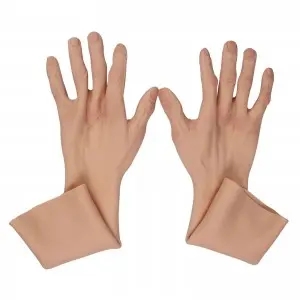
Silicone gloves are supplied as short gloves that stop near the wrist, long gloves that extend past the wrist, and extended gloves that continue into the forearm or upper arm as a single bonded piece. A common construction molds the fingers with a relaxed curvature rather than a fully straight profile, often expressed as a finger-joint bend in the region of thirty degrees, so the hand looks natural when resting. Wrist openings may be plain, hemmed, or tapered to tuck under a sleeve. The opening caliber and the finger length are the two dimensions that most affect fit, and both should be confirmed against a wearer reference rather than guessed.
Silicone Arm Covers: Segmented Versus One-Piece
Arm covers are offered as upper-arm and lower-arm segments, or as a single one-piece sleeve running from shoulder or bicep to wrist. Segmented versions are easier to size and replace, and they hide the join under clothing, but they introduce a second seam. One-piece versions look more continuous yet demand a longer mold and a more careful parting line. The choice depends on whether the wearer will keep the arm covered or expose it.
Silicone Leg Covers: Thigh, Calf, Full Leg, and Instep Extension
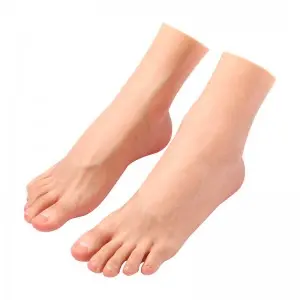
Leg covers range from thigh-only and calf-only sections to full-leg pieces, with some variants extending from the ankle across the foot to the instep so the transition is not visible above an open shoe. Full-leg pieces with instep extension are the most demanding to mold and the most prone to creasing in the carton, so they deserve extra attention in the packaging note.
Writing Length, Caliber and Circumference Without a Live Model
Specifications should be expressed as measured values on a flat reference, not as impressions of a person. Capture the total laid-flat length from top edge to fingertip or heel, the top opening caliber (inner diameter or relaxed circumference), the bottom opening caliber, and the mid-section circumference. For a size table, build columns for arm circumference, leg circumference, wrist circumference, ankle circumference and a height range, then map each to a labeled size such as S, M, L or numeric. The factory should return the table filled with its own measured values so the buyer can confirm the grade steps are even and the extremes are wearable.
Thickness and the Trade-Offs at the Joints
Thickness is the single most argued parameter in this category, because thin material looks better but fails sooner, and correct edge thinning is what separates a wearable piece from a brittle one.
Why Hands and Joints Are Usually Thinned
- Thin material at the back of the hand and across the knuckles bends more naturally and shows fewer stiff folds when the wearer moves.
- Thinning at the finger joints reduces the bulky “mitten” read that gives away a prosthetic piece in close shots.
- A reduced wall at the wrist and ankle transitions lets the edge disappear under clothing or footwear instead of standing proud.
- Uniform maximum thickness is rarely the goal; the objective is a thickness map, not a single number.
Production Limits on Thinning and Where Tears Start
- There is a practical lower limit to how thin a section can be cast before the mold cannot fill cleanly and the part tears on demolding.
- The weakest points are consistently the spaces between the fingers, the flexion creases at the finger joints, and every cut or molded edge.
- A section that is too thin at the finger web will split during the first stretch, even when the palm looks durable.
- Edges that are not thinned or rolled will curl and chip, and chipped edges are the most common reason a piece is rejected at incoming inspection.
Choosing Shore A Hardness by Zone
Hardness decides both how the piece feels and how hard it is to put on. The buyer should specify by zone rather than ask for one value across the whole part.
Soft, Hard, and the Case for Zoned Hardness
The workable approach is zoned hardness built around the right Shore A hardness: a softer zone over the hand and joints where conformity matters, and a firmer zone at the openings and along the shaft where structure and donning matter more. A softer formulation conforms to the skin and follows contours, which improves the visual, but it is harder to don, more likely to tear during stretching, and more prone to tackiness in warm storage. A harder formulation is easier to slide on and more robust in transit, but it bridges across joints and looks less like skin when the wearer bends a finger or knee.
How to Decide the Hardness Inputs
- State the intended wear duration, because longer wear favors a softer conforming zone while quick-change costume use favors a firmer, faster piece.
- State the donning method, since a piece pulled on over a bare limb tolerates less softness than one worn over a thin liner.
- State the temperature range of use and storage, because warmth reduces effective firmness and raises tackiness risk.
- Request that the factory propose a zoned hardness map with measured values on the golden master rather than committing to a single fixed number in the quotation.
Seam Lines and Why Rework Costs So Much
The parting line, or seam line, is where the two mold halves meet, and its position governs how obvious the piece looks.
Parting-Line Position and Rework Cost
- A parting line placed along the side of a finger or the back of a leg is far less visible than one across the knuckle or the front of the shin.
- Moving the line to a hidden location often requires a different mold, which changes tooling cost rather than unit cost.
- Secondary polishing and hand refining of the seam are labor intensive, and the cost rises sharply when the line falls in a high-visibility area.
- The split line that runs between two fingers is the hardest to clean, because the tool cannot reach the recess without damaging the thin web.
Why Yield Here Is Lower Than for Masks
Gloves and limb covers present long, thin, deeply recessed geometries with many undercuts, so the demolding stress is higher and the reject rate from torn edges and trapped seams is higher than for a broad, shallow mask face. A buyer should therefore expect a realistic first-pass yield conversation with the factory and build a small allowance into the order rather than assume mask-class yields.
Tip: Do not approve a bulk run from a single flawless sample, because finger-joint thinning that passes on one piece can fail across a full batch when the parting line shifts a few millimeters off the knuckle.
Skin Tone and Appearance Consistency
Color is where private-label programs live or die, because a hand that does not match the forearm is immediately obvious, and disciplined skin-tone matching is the only reliable defense.
Matching Skin Tone and Holding the Standard
- Match against a printed or physical color card under a defined lighting condition, not under warehouse daylight that shifts through the day.
- Agree a single golden master sample, lock it, and measure every batch against that master rather than against memory.
- Record the lighting source and viewing angle used for approval so the factory and the buyer judge color the same way.
- Treat the golden master as a controlled item; once it yellows or soils, the whole program drifts.
Batch Color Difference and Common Defects
Batch-to-batch variation is expressed with a Delta E value, which is the measured color distance between the production piece and the locked master under agreed lighting. The acceptable Delta E window should be written into the order as a number the buyer can measure, and any piece outside that window is reworked or rejected by the same rule every time. The defects to watch are dark nodules from unmixed pigment, trapped bubbles from incomplete degassing, surface peeling from poor cure, and powdering or chalking from filler or storage conditions. Each is controlled by process discipline: weighed pigment, adequate vacuum time, verified cure, and correct post-treatment.
Packaging and Shipping Without Adhesion Damage
These products are self-adhesive by nature, and most transit damage is caused by the piece sticking to itself or to the bag, which is why powdering and tackiness control belongs in the order, not in the warehouse.
Why These Parts Tack and How to Manage It
- Silicone naturally attracts itself, so two touching surfaces can bond permanently if left under pressure and warmth.
- Talc treatment reduces tack but can mark light tones and complicate skin-contact compliance language.
- Corn starch is a common alternative that brushes off more easily but still needs a clean final wipe for close-up use.
- Powder-free treatment relies on a surface finish and careful separation film, and is preferred where residue is unacceptable.
Inversion, Stacking Limits and Storage
Long pieces should be placed inside-out, or inverted, so the tacky inner surface faces away from itself and the outer finish is protected. Cartons must respect a stacking limit, because prolonged pressure across a folded limb cover sets a crease that becomes permanent and reads as a defect on the wearer. Full-leg and instep-extension pieces need a rigid or rolled protector so they are not bent at the ankle during transit. For long-term inventory, keep the product in a cool, dry, shaded space away from heat and plasticizers that can migrate from other stored goods, and rotate stock so the oldest pieces ship first.
Compliance Documentation and Shipping Requirements
The material baseline is platinum-cured silicone, which is preferred over tin-cured systems for cleaner cure and lower residue risk; the two differ mainly in the catalyst system and the post-cure stability. Documentation should be scoped to the actual market and use. REACH / FDA / CE compliance files should be described according to their real applicable scope, and where the exact current requirement is not certain, the document should state that the material and article are subject to the latest standard text rather than citing a fixed clause that may have changed. For protective shipping and packaging requirements, specify a three-layer build: an inner anti-adhesion separation film, a middle cushioning layer that prevents creasing, and an outer reinforced carton suited to the stacked weight, with moisture protection for humid transit lanes.
Pre-Production Sampling and Confirmation Checklist
The following list should be closed before any bulk tooling or casting starts. It is written so a buyer can send it to a factory and receive a filled reply.
Confirmation Items to Lock Before Bulk Run
- Dimension and circumference table with the factory’s own measured values for every size.
- Hardness requirement expressed as a zoned map with the soft and firm zones identified.
- Thickness distribution note showing where the wall is reduced and the measured minimum.
- Parting-line position agreed in drawing or photo, including the between-finger treatment.
- Skin-tone standard defined by color card, lighting condition and a locked golden master.
- Surface treatment specified as matte, semi-matte or gloss, with a reference swatch.
- Powder requirement stated as talc, corn starch or powder-free, with residue limits.
- Packaging and inversion requirement written into the packing instruction, not assumed.
- Defect judgment and AQL level defined by a measurable method the inspector can apply repeatedly.
- Aging and tackiness test defined by condition and duration, with the pass criterion stated.
- Private-label printing specified for logo, position, method and color fastness.
- Lead time and MOQ terms stated as the factory’s actual capacity, not a rounded promise.
- Photographic approval step confirming the golden master before the first bulk carton ships.
Common Purchasing Errors and Supplier Audit Questions
Most failed orders in this category repeat the same mistakes, and most are visible before money moves.
Five Purchasing Errors to Avoid
- Approving a single pretty sample instead of judging the thickness map and the seam across a small batch.
- Requesting one fixed hardness for the whole piece and then finding the joints either tear or bridge.
- Forgetting to specify inversion and stacking limits, then receiving creased full-leg pieces.
- Treating skin tone as a verbal description rather than a locked golden master with a Delta E window.
- Assuming mask-class yield and omitting the reject allowance the product actually needs.
Eight Questions to Ask a Supplier Before Ordering
- Which curing system is used, and can the material be documented as platinum-cured for the target market?
- What is the measured minimum wall thickness the process can hold without demold tears?
- How is the between-finger seam handled, and what is the typical rework rate there?
- Can hardness be supplied as a zoned map, and how is it verified on the golden master?
- What lighting and color card are used for tone approval, and is the master locked and returned?
- What Delta E window is offered, and how is out-of-window product separated?
- What inversion, separation film and stacking limit are built into the packing instruction?
- What is the realistic first-pass yield for this geometry, and what is the reorder consistency method?
Frequently Asked Questions
Can silicone gloves and arm covers be made in one continuous piece?
Yes, one-piece glove-to-arm covers are produced where the look must be seamless, but they require a longer mold, a more careful parting line, and closer attention to donning because the softer conforming zones make the piece harder to pull on. The buyer should weigh the visual gain against the higher tooling and rejection cost before choosing the one-piece route over a segmented build.
How should skin tone be kept consistent across reorders?
Consistency comes from a locked golden master, a defined lighting condition, a written Delta E window, and batch measurement against the master rather than against memory. The buyer should keep the master in controlled conditions and request that the factory re-measure every batch with the same instrument and light, so slow pigment or cure drift is caught before a full carton ships.
Why do these products arrive stuck together even when separately bagged?
Silicone self-adheres under pressure and warmth, so a bag alone is not enough; the inner surfaces must be separated by a film or inverted, and the carton must respect a stacking limit. Tackiness also rises with storage heat and with certain post-treatments, which is why the powder or powder-free choice and the warehouse temperature should both be specified in the order.
What is the right way to judge hardness without a fixed number?
The right way is to define the use inputs, such as wear duration, donning method and storage temperature, then ask the factory to propose a zoned hardness map with measured values on the golden master. The buyer verifies the map by handling the master and by the measured figures, rather than by accepting a single Shore A figure promised in a quotation.
Related Pages
- Different Types of Silicone Nipple Covers Explained for Buyers
- What Is a Silicone Nipple Cover? A Guide for Wholesale Buyers
- Why Private Label Silicone Nipple Covers Are a Profitable Opportunity
- Top Reasons Retailers Should Add Silicone Nipple Covers to Their Portfolio
Post time: Oct-23-2026