
Silicone Muscle Suits: Costume, Cosplay and Film Market Sourcing Guide
Silicone muscle suits sit at the intersection of three very different buying cultures: the costume and cosplay retail trade, professional film and television effects departments, and live performance wardrobes. Each of them evaluates the same physical object against a completely different scorecard. A cosplay buyer cares about how the suit photographs under flashlight at a convention. A costume department cares about how many setups it survives across a sixteen-week shoot. A theatre wardrobe supervisor cares about how fast a performer can get in and out of it between scenes. When importers approach all three with a single spec sheet, they lose margins on the retail side and lose credibility on the production side.
This guide is written for wholesale buyers, private-label distributors and sourcing managers who are building or extending a muscle suit programme. It focuses on selection logic and purchasing parameters specific to the cosplay, costume and screen channels, rather than on general silicone garment construction. Every parameter below is something you should be able to put on a request-for-quotation form and expect a supplier to answer in writing before you release a deposit.
Market Map: How Each Channel Buys Differently
The first practical step is to decide which channel your range is built for, because the channel dictates thickness, finish, packaging and reorder rhythm far more than any aesthetic preference does.
- Cosplay and costume enthusiasts buy through e-commerce, specialist costume shops and convention retail. Orders are single-unit heavy, size-skewed toward medium and large, and highly seasonal around Halloween, comic conventions and carnival periods. Visual impact under camera flash matters more than eight-hour comfort, but returns rise sharply if the suit is too heavy to wear for a full day. Typical reorder cycle is quarterly with a strong pre-season build.
- Film, television and special-effects makeup departments buy fewer units at higher unit value and expect continuity: the same sculpt, the same shade, the same batch behaviour across a production run. They frequently order a hero version plus a stunt or photo-double duplicate, and they require repairability on set. Documentation, consistency and lead-time reliability outweigh unit price.
- Stage, theatre and live performance wardrobes prioritise fast changes, breathability under hot lighting and repeated donning cycles. Seams and entry structures take more abuse here than in any other channel, and wardrobe teams expect a repair protocol to be supplied with the garment.
- Crossdress, drag and transformation retail channels overlap with the costume trade on distribution but behave differently on two dimensions: far higher sensitivity to discreet packaging and shipping descriptors, and a stronger preference for upper-body formats that can be worn under existing wardrobe pieces. Confirmed adult-use buyers in this segment are commercially important and should be served with neutral, professional product language and privacy-first logistics.
A practical approach is to run one core sculpt with two specification tiers: a retail tier with a matte, camera-ready finish and lighter overall weight, and a production tier with reinforced seam construction, a documented repair kit and shade-batch traceability.
Product Formats: Upper-Body, Full-Body and Localized Panels
Format choice drives freight weight, mould investment and the size of your addressable market more than any other single decision.
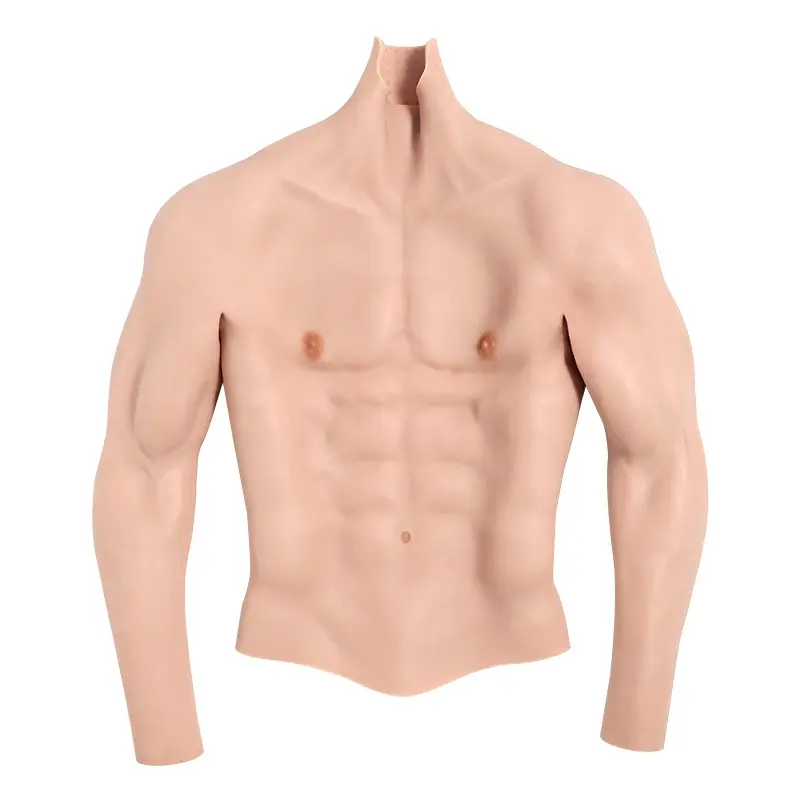
- Upper-body muscle suits cover the torso from the base of the neck to the waist or hip line, with or without sleeves. They are the highest-volume format because they pair with ordinary trousers or costume bottoms, they are roughly half the weight of a full suit, and they can be worn under clothing. They are the default recommendation for cosplay retail and for crossdress and drag channels.
- Full-body muscle suits extend coverage to the legs and sometimes the feet and hands. They are heavier, slower to don and require a second person for dressing, but they are the only viable option for creature and character work where the camera sees the whole silhouette. Film and high-end stage work justifies the cost; general retail rarely does.
- Localized muscle panels and patches cover a single region such as the chest, abdomen, shoulders, calves or forearms. They are the entry-level SKU: lowest unit cost, lowest shipping weight, easiest to fit, and an effective tool for testing demand in a new market before committing to a full sculpt. They also serve as repair stock when a full suit is damaged in one zone.
For a new programme, a sensible launch matrix is one upper-body sculpt in four sizes, two localized panels, and one full-body option held as a made-to-order item rather than stocked inventory.
Thickness Zoning: Thin Where It Moves, Thick Where It Carries
A muscle suit fails visually when it is uniformly thick. Uniform thickness reads as a wetsuit. The convincing effect comes from thickness zoning, where the wall section varies across the body to mimic the behaviour of real tissue over muscle and bone.
- Chest and abdominal zones: the thinnest structural area, typically around 1.5 to 3.0 mm. Thin sections here let the underlying muscle definition flex and ripple with the wearer, which is what sells the illusion in motion and under harsh light.
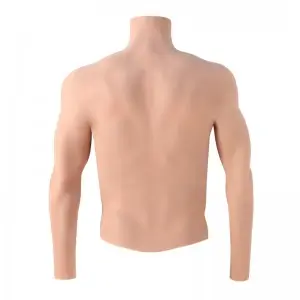
- Back and shoulder zones: considerably thicker, generally 4.0 to 8.0 mm, because these areas carry the tensile load of donning and must resist tearing at the shoulder cap and across the lat spread. They also hide the support structure of the sculpt.
- Edge feathering: all free edges taper to roughly 0.5 to 1.0 mm over a transition band of 20 to 40 mm. Feathered edges disappear under fabric and prevent the visible “step” line that makes a prosthetic look obvious at collar, wrist and leg openings.
- High-stress local reinforcement: zipper tapes, neck openings and underarm gussets are built up with a local patch to roughly 6 to 10 mm, because these are the points where a suit tears first.
Ask your supplier to state thickness as a zoned map rather than a single number, and to confirm the feathering band width. A quote that only offers “3 mm overall” is telling you the sculpt was not engineered for this category.
Material: Platinum-Cure vs Tin-Cure Silicone, and Shore A Zoning
Two decisions govern how the suit performs over its service life: the cure chemistry and the hardness distribution.
- Platinum-cure (addition-cure) silicone: near-zero shrinkage, no cure by-products, no residual odour, excellent long-term colour stability and very high elongation. It is skin-contact safe once post-cured and is the only realistic choice for film work, for anything worn for more than a few hours, and for export markets with chemical compliance requirements. Cost is higher.
- Tin-cure (condensation-cure) silicone: substantially cheaper and adequate for short-wear novelty or display pieces. It shrinks measurably over weeks, releases a mild odour during cure, is prone to yellowing under UV, and bonds less predictably to pigment and to itself during repair. It is not appropriate for a programme positioned on quality.
Hardness is specified on the Shore A scale and, like thickness, should be zoned rather than uniform. Practical values for this category are:
- Chest and abdomen: Shore A 5 to 10. Very soft, so the surface moves with the body and reads as skin rather than rubber.
- Shoulders and upper back: Shore A 12 to 18. Firmer, to hold the sculpted silhouette and resist tearing under load.
- Free edges and blend zones: Shore A 3 to 6. Extremely soft so the transition onto bare skin is gradual and the edge does not lift.
- Seam and zipper reinforcement: Shore A 20 to 25, applied as a local backing strip to give mechanical anchoring for stitching or adhesive.
Specify that the hardness values must be measured on finished production parts with a calibrated durometer, not quoted from the raw material datasheet, because catalyst ratio and post-cure time shift the final reading.
Sizing System and International Conversion
Muscle suits are compression garments. They are designed to fit tighter than street clothing, and that single fact causes most of the sizing disputes in this category. Build your size chart on body measurements, not on apparel sizes, and publish the ease allowance explicitly so customers understand the garment will feel snug.
- Core measurement points: chest circumference at fullest point, natural waist, hip, neck base, shoulder width, bicep circumference, torso length from neck base to waist, and total height. Upper-body formats require at least seven of these.
- Standard grading: a five-size run from S to XXL covering chest 88 cm to 122 cm with roughly 8.5 cm grade between sizes, plus a height split (regular and tall) for the full-body format.
- Regional conversion: publish chest in centimetres and inches, and map to US and UK numeric chest, EU and Asian letter sizing on the same chart. Many returns in cross-border e-commerce come from customers choosing an Asian size label and expecting a US fit.
- Custom body allowance: for made-to-measure orders, add 2 to 3 cm of negative ease at chest and waist for compression, and 1 to 2 cm positive ease at the neck base and shoulder to allow donning. Request photographs of the measurement process and a signed measurement sheet before the mould is cut.
- Sleeve and leg length: grade separately from torso length. A single-length sleeve across five sizes is the most common cause of poor fit complaints on full-body formats.
Skin Tone and Surface Finish
Under convention lighting and under cinema lighting, the same suit behaves very differently. Finish specification should therefore be part of the commercial brief, not an afterthought.
- Shade library: maintain six to twelve base tones spanning fair, light, medium, olive, tan, deep and ebony, each with a physical reference chip. Insist on a shade tolerance standard and on batch-to-batch matching under a specified light source.
- Multi-layer colouring: internal tint gives depth and prevents the painted look; external pigment layers add mottling, sun-exposed variation and freckling. Three to five layers is typical for a production-grade finish.
- Matte treatment: a matte or semi-matte topcoat is essential for camera work. Untreated platinum silicone is glossy and reads as plastic under flash. Specify the topcoat as a durable, non-migrating system that will not turn tacky in storage.
- Vascular and texture detail: superficial veins, pore texture, hair follicle stippling and tendon definition are applied by hand. This is the largest single driver of skilled labour cost and the clearest visible difference between a budget and a premium unit.
- Pigment stability: use UV-stable, non-bleeding pigments that will not migrate into costume fabric or onto other garments, and request a rub-fastness result before bulk confirmation.
Entry Structure: Zippers, Neck Openings and Hidden Seams
The entry system determines whether the suit is wearable in practice. A sculpt that looks excellent on a mannequin but takes twenty minutes and an assistant to put on will generate returns regardless of its visual quality.
- Back zipper: the most common solution. Specify a heavy-duty invisible zipper with a fabric guard strip behind it to prevent skin pinching, a silicone sealing flap over the teeth to hide the line, and a long pull cord so the wearer can self-close.
- Front zipper: allows independent donning and is preferred for cosplay retail, but it runs through the abdominal definition where it is hardest to conceal and should be avoided on film hero suits.
- Neck opening: cut to follow the trapezius line, not straight across. A straight collar edge is the single most visible giveaway in close-up work. Reinforce the opening with a local backing strip to prevent tearing during repeated donning.
- Hidden seam placement: place any seams along the lateral line beneath the arm, under the pectoral fold, or along the natural gluteal or lat boundary. Never place a seam across the centre of the chest or abdomen.
- Dressing protocol: supply a written donning sequence with the garment, including use of talc or a water-based dressing aid, and state realistic donning time with and without assistance.
Durability, Repair and Storage
Muscle suits are expected to be repaired, not replaced. A documented repair and storage protocol protects your margin and reduces warranty claims.
- Tear strength and elongation: require the material datasheet to state tear strength and elongation at break, and request an internal pull test on the shoulder and zipper zones. Ask for a stated service-life figure in wear hours under normal use.
- Repair kit: ship each unit, or each carton, with a small repair kit containing platinum RTV adhesive, primer, a spatula, matching pigment and a disposable applicator. Confirm the adhesive chemistry is compatible with the base silicone; cross-chemistry repairs fail within days.
- Repair process: clean with isopropyl alcohol, abrade lightly, apply primer, apply adhesive in a thin layer, clamp with light pressure, cure at the stated temperature and time, then seal and matte the repaired area. Provide this as a printed card and as a downloadable document.
- Storage: dust the surface with talcum powder or cornstarch after cleaning and drying. Never store two silicone surfaces pressed directly together, because they can cold-weld and block. Hang upper-body suits on a broad padded hanger or store flat with tissue support; never fold sharply across the abdominal zone.
- Environment: store away from direct sunlight and heat sources, ideally between 10 and 30 degrees Celsius, in a dry place. Avoid contact with solvents, mineral oils and copper, all of which degrade or discolour silicone.
Tip: Talc is a consumable, not a one-time treatment. Make a 30 g sachet a standard inclusion in every retail carton and mention it on the care card. This single low-cost item prevents most of the blocking and surface-tack complaints that would otherwise become returns.
Privacy, Packaging and Discretion Requirements
Discretion is a functional requirement in this category, not a courtesy. It affects packaging design, carrier documentation, payment descriptors and returns handling, and it should be specified in the purchase contract rather than assumed.
- Neutral outer packaging: plain corrugated carton with no product imagery, no suggestive wording and no brand marks that reveal the contents. Use a generic shipper name and a non-descriptive return address.
- Shipping documentation: use neutral product descriptors on commercial invoices and on the parcel label. Confirm the HS classification with your broker before the first shipment, because misclassification is a common cause of customs delay for silicone garments.
- Billing discretion: for direct-to-consumer fulfilment, agree with the payment provider on a neutral statement descriptor and confirm it in writing before launch.
- Return and refurbishment policy: define clearly which returns can be restocked. Because of hygiene considerations, worn units should be quarantined on receipt, professionally cleaned and inspected for structural integrity, then either refurbished into a graded resale channel or destroyed with a documented destruction record. State the policy on the product page so buyers understand it before ordering.
- Data handling: size and measurement data collected for custom orders is personal data. Confirm retention periods and storage location with your compliance team, particularly for EU and UK customers.
MOQ, Sampling Lead Time, IP Risk and the RFQ Checklist
The commercial terms of a muscle suit programme are heavily front-loaded. Mould investment and hand-finishing capacity determine cost structure more than raw material does.
- MOQ: expect a lower MOQ for stocked sizes in existing sculpts, commonly in the range of 10 to 50 units per size run depending on finish complexity, and a substantially higher minimum for exclusive sculpts or private-label moulds.
- Sampling cycle: allow 10 to 18 working days for a first sample in an existing sculpt with standard shade, and 25 to 40 working days for a new sculpt including sculpt approval, mould making, first pull and finishing. Add courier transit and one revision round on top.
- Tooling: new sculpts carry a one-time mould charge. Clarify ownership of the mould, whether it is exclusive to your account, and the maintenance or replacement terms after a defined number of pulls.
- Intellectual property risk: only commission original anatomy sculpts. Do not reproduce a specific actor’s likeness, a named superhero costume, or a studio-owned character design without written licence. Require your supplier to confirm in the contract that all sculpts supplied are original and to indemnify you against third-party design claims. Decline requests to replicate trademarked character looks.
- Compliance: request material safety documentation for skin contact, plus any market-specific chemical compliance evidence required in your destination, before bulk production rather than after.
RFQ data checklist to include on every enquiry: format (upper-body, full-body or panel), sculpt reference or custom brief, size range with measurement chart and target market, zone-by-zone thickness map, Shore A values by zone, platinum or tin cure confirmation, shade reference and finish level, entry structure and seam placement preference, packaging requirement including neutral-pack confirmation, target quantity per size, target unit price and Incoterm, required certifications, and first-article approval process.
Custom sculpt programmes should always include a written stage-gate sequence: concept reference, clay or digital sculpt approval, mould release, first-article sample, wear test, then bulk. Releasing bulk before first-article wear testing is the most expensive shortcut available in this category.
Quality acceptance criteria should be agreed in writing before production: edge feathering without visible steps, no pinholes or trapped bubbles on visible surfaces, zipper running true with a flush guard strip, shade within tolerance against the approved chip under specified lighting, and no seam positioned across the chest or abdominal centre line.
Discreet packaging standards belong in the same contract as the product specification, not in an email exchange, because they are the requirement most often lost between the first sample and the first bulk shipment.
Buyers who treat muscle suits as engineered products rather than novelty goods consistently outperform those who shop on unit price alone. Specify the zoning, the chemistry, the hardness map and the finishing standard in writing, approve a first article under real lighting and real wear conditions, and the category rewards you with high perceived value, strong repeat purchase behaviour and a defensible position against low-quality competition.
Related Pages
- Different Types of Silicone Nipple Covers Explained for Buyers
- What Is a Silicone Nipple Cover? A Guide for Wholesale Buyers
- Why Private Label Silicone Nipple Covers Are a Profitable Opportunity
- Top Reasons Retailers Should Add Silicone Nipple Covers to Their Portfolio
Post time: Oct-19-2026